
Posted on

Keep the Hard Days Hard and the Easy Days Easy

After a decade and a half in gyms, weight rooms, coaching, and as an athlete myself, I’d say that there is one nearly over-reaching pattern that I have observed: most people train at too high of an intensity far too often. More accurately, they end up trying to train at too high of an intensity but, for reasons I’ll soon explain actually end up training in a medium intensity no-man’s land.

In this article, I want to argue fairly strongly for the inclusion of both hard and easy days in training. The key in this approach, and this is what I’ll address, is that the goal should be to keep the hard days hard and the easy days easy. This will make more sense shortly.

Alternating Hard and Easy Days

The original idea of alternating hard and easy days appears to have come out of early running training (probably the Oregon system under Bill Bowerman). … Keep Reading
Posted on

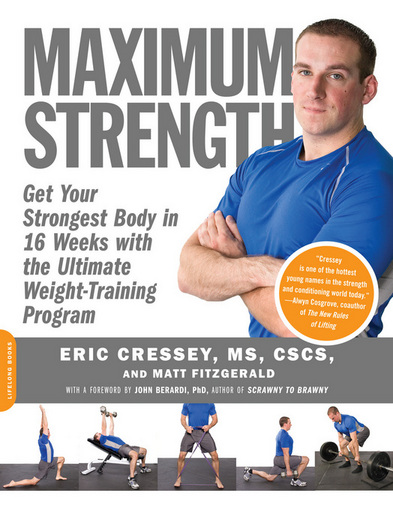
Eric Cressey’s Maximum Strength

Eric Cressey's Maximum StrengthI hadn’t done a product review in a while and Eric was nice enough to send me a copy of his new book so I thought I’d finally sit down and review the thing, having read it last week.

For those of you who aren’t familiar with Eric Cressy, he sort of started as a “rehab/shoulder” guru but has established himself as an overall performance enhancement coach. His articles on shoulder health and posture on T-nation.com are excellent and I’d highly recommend them to anyone with shoulder issues or who is having the types of postural issues endemic to modern society.

You can find links to all of Eric’s articles here. I strongly suggest reading the Neanderthal No More series.

He’s done previous products including Magnificent Mobility (essentially a “catalog” of various warm-up rehabby types of movements, I think it lacked in not showing trainees how to put things together in a coherent routine) along with his Ultimate Off-Season Training Manual e-book.… Keep Reading

Posted on

Steady State vs. Intervals: Summing Up

In the previous article, I looked at research examining The Metabolic Effects to Short-term High-intensity Interval Training.

Summing up briefly, it showed quite clearly that, at least in relatively untrained individuals, a short-term (2-6 week) program of high-intensity interval training (workouts typically done three times per week) can generate similar adaptations to longer duration training.

In that post, I finished by asking the following questions:

There’s no doubt (and I haven’t intended to suggest otherwise) that high intensity interval training can have benefits. It’s time effective and may induce similar performance adaptations to longer duration traditional cardio. With regards endurance athletes, it’s clear that even short periods of low volume interval training can have rather large benefits for performance.

But with most of the benefits seeming to occur with only a handful of sessions per week (2-3 is the norm) and with benefits appearing to end fairly quickly (3-6 weeks), we might ask what a trainee should do when either

  1. They need to train more frequently than that
  2. They are looking at their training over a period longer than a few weeks.
Keep Reading
Posted on

Metabolic Adaptations to Short-Term High-Intensity Interval Training

Continuing from my discussion of Exercise Efficiency, I want to dip back into the research and look at the metabolic adaptations to high-intensity interval training (HIIT).  Specifically I want to look at the following review.

Gibala, MJ and SL McGee. Metabolic Adaptations to Short-Term High-Intensity Interval Training: A Little Pain for a Lot of Gain. Exerc Sport Sci Rev (2008) 36: 58-63.

Which looks at the research (as of 2008) on the adaptations seen with HIIT.   In this regard the researchers state:

High-intensity interval training (HIT) is a potent time-efficient strategy to induce numerous metabolic adaptations usually associated with traditional endurance training. As little as six sessions of HIT over 2 wk or a total of only approximately 15 min of very intense exercise (approximately 600 kJ), can increase skeletal muscle oxidative capacity and endurance performance and alter metabolic control during aerobic-based exercise.

My Comments

It’s long been felt or argued that the only way to reach the pinnacle of endurance performance is through years of grinding effort, usually involving absolute piles of low-intensity training.… Keep Reading

Posted on

Explaining Exercise Efficiency

Continuing with the topic of steady state vs. interval training, I want to look at the topic of exercise efficiency.  This is an aspect of exercise physiology that is misunderstood by most who write about it.  And sadly this misunderstanding is what leads them to draw some very bad conclusions.

What is Exercise Efficiency?

You can consider this article a sort of side-trip about the whole issue of intervals versus steady state cardio that I’ve been discussing in the previous articles. I’ve mentioned exercise efficiency briefly in a couple of posts but want to make some more detailed comments before continuing on with the series..

One of the common arguments against steady state cardio is something akin to ‘Steady state is useless because you become more efficient at it and burn less calories doing it.’

I’ve already addressed part of why this argument is stupid but want to go into a bit more detail.… Keep Reading