
Posted on

Adjusting the Diet

In various places on the site, I have made the comment that such things as caloric intake and activity will have to be adjusted based on real-world fat loss.   This is a big part of the reason I tend to quick-estimate maintenance calorie intakes to begin with.  Any value you come up with whether you quick-estimate it or use some complex approach is only a starting point.  If you have to adjust it anyhow, the quick method is usually good enough.

But that raises the question of how to actually adjust the diet based on real world changes in body composition.  Even that is contingent on being able to get an accurate measure of body composition.  For the most part, I’ll be addressing moderate dietary deficits.  But the same information would mostly apply if large or small deficits were being used.

A Quick Note About Water Balance

Before I get into the meat of the article, there is one topic I want to bring up first. … Keep Reading
Posted on

Back Extension Technique

Today I want to talk about the back extension exercise, which I often is not always include in workouts.  Yes, other movements such as the Romanian Deadlift work the low back but it is mostly isometrically.  That is, there is no movement in the low back.  Or there shouldn’t be.  The back extension complements the movement by training the spinal erectors dynamically.

From a safety standpoint, I think there is benefit to working the spinal erectors through full flexion and extension since there are times when the back simply can’t be kept flat. Low back strengthening can also benefit squats and deads simply by ensuring that they aren’t a weak point in the movement.  That’s in addition to any safety benefits.

The simple fact is that heavy squats and deadlifts can often go awry during maximal or near maximal sets, folks lose form no matter how hard they try not to; this often involves rounding of the upper or lower back or both. … Keep Reading

Posted on

Lifting Six Days a Week

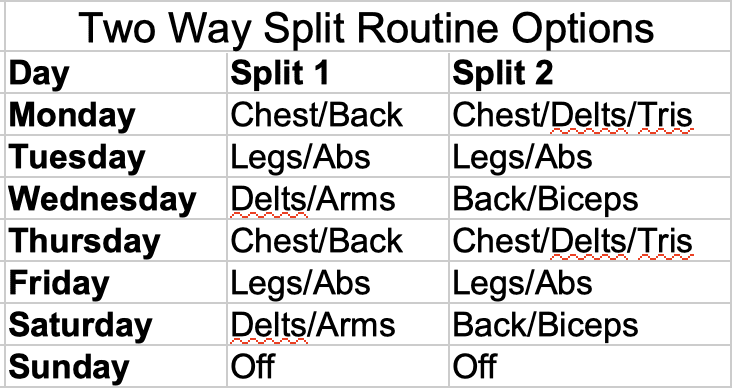
Two Way Split Routine Options

The reality of the world is that people are busy.  And while it’s easy to assume that people have endless time to devote to the gym, that’s not universally the case.    Not everyone can devote 1-1.5 hours to a workout if they have a full work and family schedule.   What’s the solution?  One is to perform shorter workouts during the week and longer workouts on the weekend when most have more time.  Another is to set up a workout that has the person lifting six days per week with much shorter daily workouts.  So let’s look at how to set that up to make optimal progress without overuse injuries.

Problems Lifting Six Days a Week

Let me note ahead of time that training with this high frequency can cause problems and there are a number of pitfalls that need to be avoided.  Of course general overtraining is one of them but, more specifically is the issue of connective tissue and general overuse injuries.… Keep Reading

Posted on

Dietary Fiber – It’s Natures Broom

Years ago I remember lamenting (and writing somewhere) that I was fairly sick of reading research papers on how eating more dietary fiber was good for people, how it was time for nutritional science to move into relatively more interesting things than a topic that had literally been beaten to death.

Thankfully, soon thereafter leptin was discovered and nutritional researchers could start looking at things more interesting than why eating high-fiber vegetables were good for you (a nutritional tidbit that I file under the “Grandma was right” category).

Even so, there is still some confusion out in the world of nutrition regarding fiber.  And boring or not, it’s a topic worth clearing up.  So today I want to take a fairly comprehensive look at dietary fiber, what it is, what it does in the body, how it impacts on things like body composition (and health to a lesser degree) and finish by looking at some (admittedly vague recommendations).… Keep Reading

Posted on

A Look at Spot Reduction

The idea of spot reduction, reducing body fat in a specific area with exercise, is one that has floated around the fitness body recomposition world for decades.   Men want the ever desirable six-pack and can be seen doing abs until the cows come home while women try to slim hips and thighs with endless reps on the inner/outer thigh machine.

Exercise classes pander to this, offering hour long “abs” or “buns/thighs” classes which usually consist of a billion reps of movements that work the target area.  Even in the bodybuilding world, where people really should know better, some still argue that spot reduction can occur and that working a given muscle group will help reduce fat in that specific area.   I addressed this topic somewhat in The Stubborn Fat Solution since some of what I discuss in that book could readily be confused with spot reduction even though it’s really not.… Keep Reading